
Britain's Phantom Panics

For all our confidence in reason, progress, and science, ghosts have a curious habit of resurfacing precisely when we believe we have outgrown them. Britain, in particular, has a long and revealing history of ghost panics—moments when fear, rumour, and expectation combine to produce apparitions that feel utterly real to those who encounter them. These stories are not simply about belief in the supernatural; they are about society, psychology, and the fragile boundary between fear and certainty.
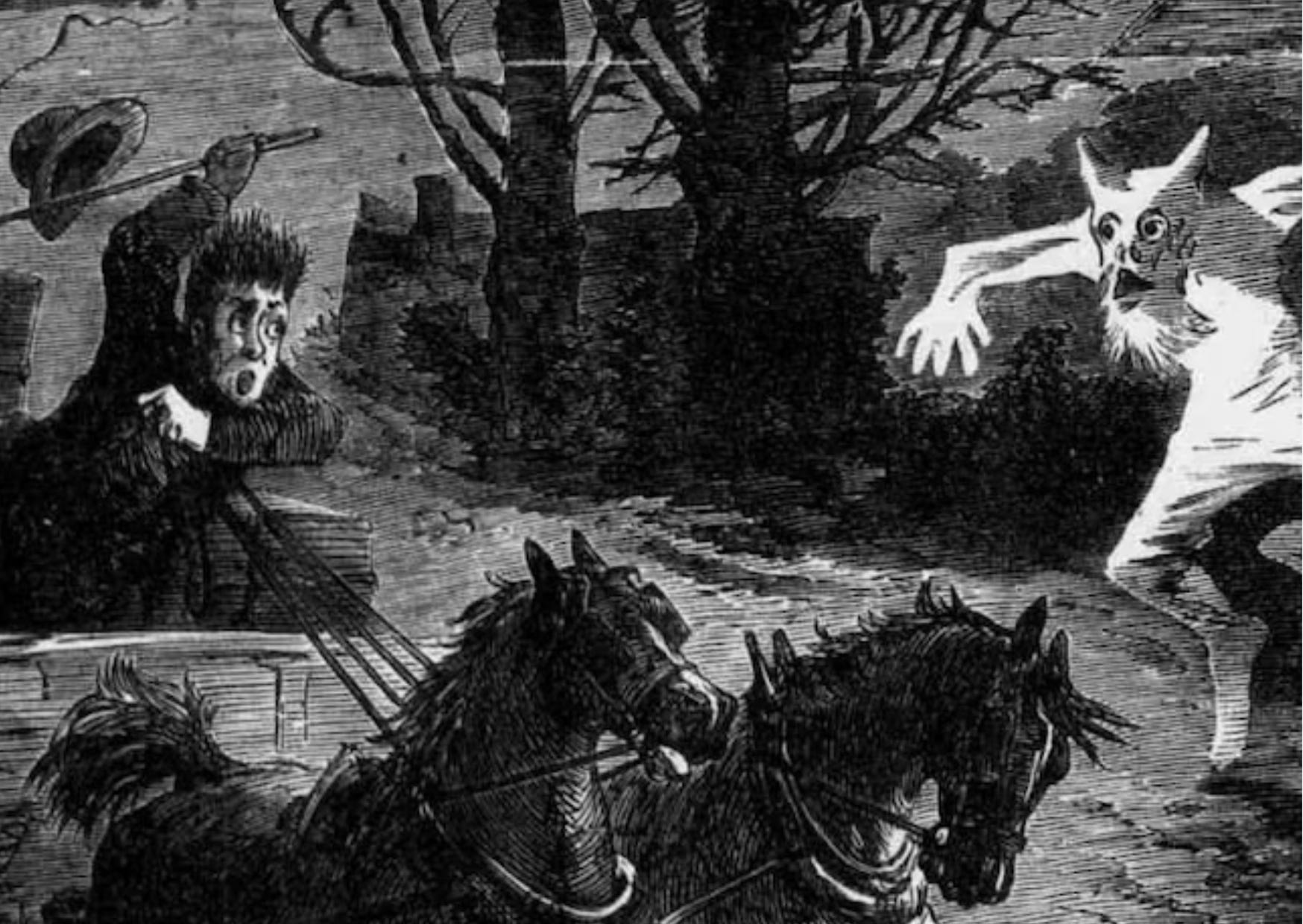
Few cases illustrate this better than the infamous Hammersmith Ghost Hoax of the early nineteenth century, a tale that spiralled from whispered sightings into public hysteria, vigilantism, and tragedy. It is a story that echoes through later cases across the UK, revealing a recurring pattern: when communities expect to see ghosts, they often do.
The Hammersmith Ghost: A Spectre Takes Shape
The Hammersmith Ghost first appeared in late 1803 in the riverside parish of Hammersmith, then a semi-rural village on the outskirts of London. Reports began quietly. Locals spoke of a pale figure wandering churchyards and lanes at night, said to glow faintly and float above the ground. Some claimed it wore white burial garments; others insisted it resembled a shrouded corpse.
Almost immediately, the ghost acquired a story. It was said to be the restless spirit of a suicide, denied Christian burial and condemned to wander the earth. This narrative mattered. Ghosts with origins—especially tragic or sinful ones—feel more credible. They slot neatly into existing cultural beliefs about death, punishment, and unrest.
Soon, sightings multiplied. Witnesses described being chased, knocked down, or frozen with terror. Pregnant women reportedly fainted; one was said to have miscarried from fright. Whether these claims were exaggerated or sincere is impossible to know, but what is clear is that fear spread rapidly.
Importantly, these accounts did not remain private. They appeared in newspapers, were discussed in taverns, and retold in drawing rooms. The ghost was no longer just a rumour—it had become a public presence.
Vigilantes, Weapons, and Expectation
As fear intensified, locals took matters into their own hands. Armed patrols began roaming the streets at night, carrying clubs, firearms, and makeshift weapons. The assumption was simple and dangerous: if the ghost could be confronted, it could be dealt with.
This expectation primed people to see the supernatural everywhere. A white laundry bag, a reflection, a figure moving in the dark—anything could become the ghost once fear had sharpened perception.
That danger became horrifyingly clear on the night of 3 January 1804.
The Death of Thomas Millwood
Thomas Millwood was a bricklayer’s apprentice. Like many working men of the time, he wore white clothing to protect his clothes from lime and dust. That night, returning home from work, he walked through Black Lion Lane.
A watchman named Francis Smith saw him.
Smith, already primed by weeks of ghost stories, was convinced Millwood was the apparition. He challenged him. Millwood reportedly responded, possibly laughing or dismissing the accusation. Smith fired his gun.
Millwood died almost instantly.
At Smith’s trial, the court faced an uncomfortable truth: this was not a murder born of malice, but of fear. Smith genuinely believed he was confronting a ghost. The jury convicted him of manslaughter rather than murder, and he was sentenced to a year’s hard labour.
The ghost, however, did not disappear.
Exposing the Hoax
Shortly after Millwood’s death, the mystery unravelled. A local shoemaker, John Graham, was accused of impersonating the ghost, reportedly wearing a white sheet to frighten his apprentice as a prank. Whether Graham was responsible for all sightings remains uncertain, but his exposure punctured the illusion.
The Hammersmith Ghost was no longer supernatural—it was human.
Yet the damage had been done. A man was dead, and an entire community had been caught in a collective hallucination fuelled by fear, expectation, and repetition.
Why the Hammersmith Ghost Matters
The Hammersmith Ghost Hoax is often retold as a curiosity, but it deserves closer attention. It reveals how easily fear can override reason, even in an era that prided itself on Enlightenment values.
It also highlights a recurring truth: ghosts flourish where social anxiety thrives. Hammersmith at the time was undergoing change—population growth, urban expansion, and social tension. The ghost provided a focus for unease that lacked a clearer explanation.
This pattern would repeat itself again and again.
In 1891, residents of Islington reported a violent apparition that attacked passers-by. Witnesses described being struck or chased by a shadowy figure. As with Hammersmith, crowds gathered nightly, armed and eager to confront the spectre.
Newspapers amplified the story. Illustrations showed dramatic encounters. Rumour hardened into certainty.
Eventually, the “ghost” was exposed as a series of pranks carried out by local youths. But by then, the panic had already transformed ordinary streets into theatres of fear.
The ghost did not need to be real. It only needed to be expected.
Newspapers as Ghost Factories
One striking feature of these cases is how often they appeared in newspapers. This was a period when local papers were hungry for sensation, and ghost stories sold well.
Once a haunting was reported, it gained legitimacy. Readers assumed that if it was printed, it must be credible. Reports were copied, embellished, and spread across regions.
This created feedback loops. People went out looking for ghosts—and unsurprisingly, they found them.
Today, it is worth asking how many private fears became public panics simply because they reached print. Modern equivalents may be found not in newspapers, but in social media feeds and viral videos.
Lessons from the Past
The Hammersmith Ghost Hoax and its successors offer uncomfortable lessons. They remind us that rational societies are not immune to panic, and that fear does not require ignorance to flourish—only uncertainty.
They also demonstrate how easily blame can be misplaced. Innocent people, like Thomas Millwood, suffer when communities act on belief rather than evidence.
Yet these stories endure not because they shame us, but because they fascinate us. They sit at the intersection of history, psychology, and folklore, asking questions that remain unresolved: Why do we see what we expect to see? Why does fear feel so real? And why, even now, do ghosts still walk among us?
Ghosts as Mirrors
Perhaps the most unsettling conclusion is this: ghosts rarely tell us about the dead. They tell us about the living.
They reveal what a society fears, suppresses, or cannot explain. In Georgian Hammersmith, that fear was disorder and change. In Victorian cities, it was crime and moral decay. In the modern world, it may be uncertainty itself.
The ghosts change. The panic does not.
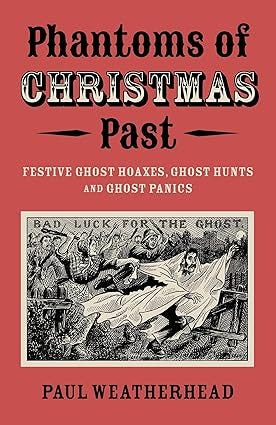
If you enjoyed this exploration of Britain’s ghost hoaxes and panics, you can watch the full conversation with Paul Weatherhead on Haunted History Chronicles, now available on YouTube and via the website.
https://www.youtube.com/@HauntedHistoryChronicles
Because long after we stop believing in ghosts, they never quite stop believing in us.
https://www.amazon.co.uk/Phantoms-Christmas-Past-Festive-Hoaxes-ebook/dp/B0FJJRRKNT
Interesting read!